
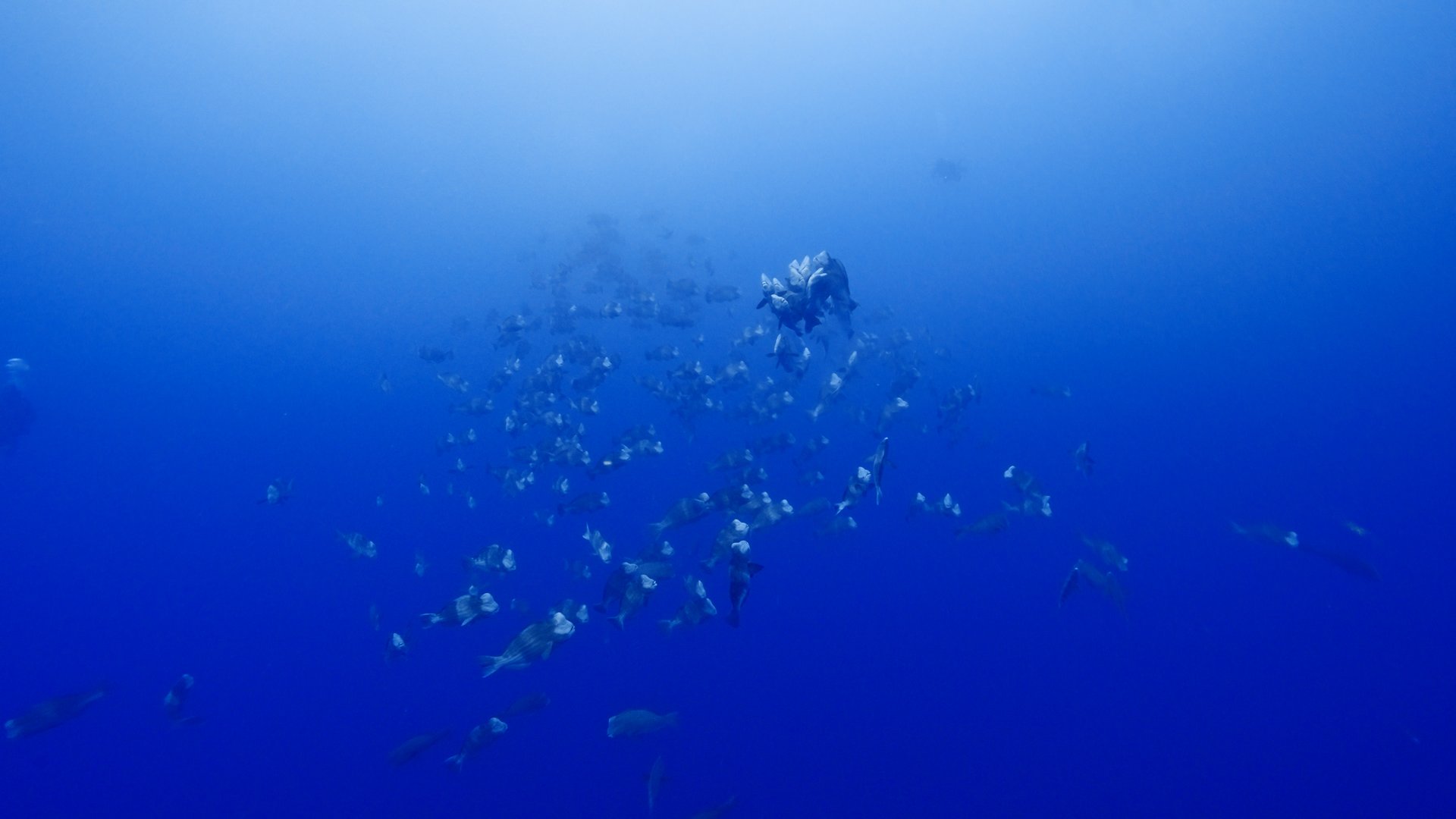
Diving in Palau: Bumphead Parrotfish Mass Spawning Aggregation
An honest account of what it’s like to witness the world-famous mass spawning phenomenon.
2/24/20263 min read
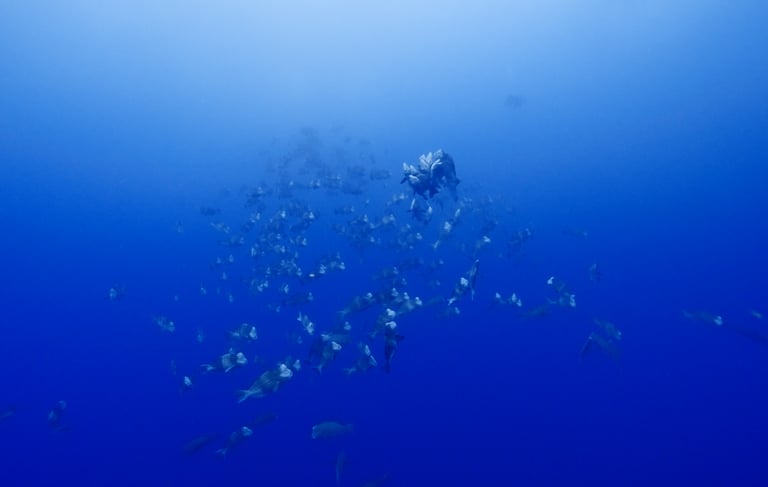
We first came to Palau in December 2023, timing our visit to coincide with the bumphead parrotfish’s mass spawning aggregation, which takes place around the new moon each month. Unlike many fish spawning events that are irregular or difficult to predict, bumpheads in Palau reliably gather along specific sandy reef slopes at this time, making it one of the only places in the world where divers can witness the spectacle with certainty. The experience was unlike anything we’d ever had.
ARRIVAL
Three days before the new moon, we arrived at the site just after daybreak to find about ten other dive boats already there. There was a sense of anticipation in the air, everyone on standby. Our guide, Clayton, explained that we had to wait until the bumpheads’ faces turned white, a sign that spawning was imminent. We watched as he donned his mask and fins and slipped into the water to peer into the depths. Our boat, along with a dozen others by the, hovered above the reef’s edge.
After a couple of quick dips, Clayton climbed back aboard with urgency. “It’s time!” he gasped, breathless from the swim. Excitement surged through the boat as we hurried into the water (we’d already geared up while waiting). Around us, divers from other boats were doing the same, each group eager to be first in. Someone in our group did the math out loud: if each boat carried ten divers and we’d counted fourteen boats, that meant 140 divers on a single site. It was an insane thought. We didn’t know what to expect.
THE DIVE
We descended quickly and claimed a patch of sand at the reef’s edge to regroup. There was still no visible spawning activity, though bumpheads cruised in the distance. We scanned the blue eagerly and turned to find a dense crowd of latecomers behind us: divers who hadn’t managed to secure a front-row position. We waited another fifteen minutes.
Then the aggregation tightened.
Bumpheads circled low over the reef, bodies brushing, bumping, posturing. Dominant males charged rivals in blunt, head-on collisions.
Then it happened.
A female rose into the blue and several males surged after her. In a sudden vertical rush, they released eggs and sperm mid-water as their bodies shuddered. A pale cloud bloomed between them, and just as quickly they dispersed and returned to the reef.
And then it repeated. Here, there, everywhere!
Clayton signaled for us to move off the reef and into the blue, careful not to get too close and disrupt their behaviour. The scene was astonishing: dozens of spawning clusters erupting around us, while hundreds more formed a streaming school that shifted direction so unpredictably it was impossible to anticipate their next move. At times the school swept past us; at others, mating bursts exploded right in front of us. It looked like underwater fireworks, clusters shooting upward and detonating into milky clouds.
In the chaos and exhilaration, we often lost sight of our buddies. But Clayton wore a bunny-eared hood for exactly this reason, making him easy to track so we didn’t drift too far apart. We knew we were witnessing something sacred: the making of life, of a keystone species, the gardeners of the reef. Whenever we locked eyes with our buddies amid the chaos, we exchanged disbelieving head shakes and that universal "mind-blown" hand signal.
Of course, we didn't expect all 140 divers would behave.
True enough, many did not.
We watched divers chase bumpheads or push too close to spawning clusters, causing the fish to scatter and attempt mating again elsewhere. Clayton had warned us not to position ourselves above the fish, which would force them deeper and disrupt their movements. Yet we saw divers driving schools down past 20 metres, cameras thrust forward like spears and shields.
In those moments, the magic of the spawning felt diminished by reckless behaviour. In our privilege to witness something less than one percent of the human population will ever see with their own eyes, many forget that nature is not staged as a show for our entertainment.
THE VERDICT
On the boat ride back, we fell silent, each of us lost in quiet reflection over what we had just experienced. We wondered what impact our presence had on the bumphead parrotfish, and whether we would continue to have the privilege of witnessing this spectacle if irresponsible diver behaviour goes unchecked.
And yet, hope lingers. Palau has shown that protection and firm management can bring species back from the brink. Perhaps with stronger awareness, stricter enforcement, and a deeper understanding of what we are truly witnessing, this ancient ritual will continue to unfold with each new moon long after we are gone. Would we do it again? A resounding YES, but only with a responsible dive guide, like Clayton, who laid out the rules of the dives clearly and made sure each of our group understood and respected the importance of such rules. (Also, yes we would do this dive again because the external hard disk containing our precious footage that we collected from this trip had decided to die. Oh the pain).
Check out the cinematic trip summary video of our adventures in Palau back in 2023! (It's some of the few surviving visual evidence we have left * crying bitterly *)

